
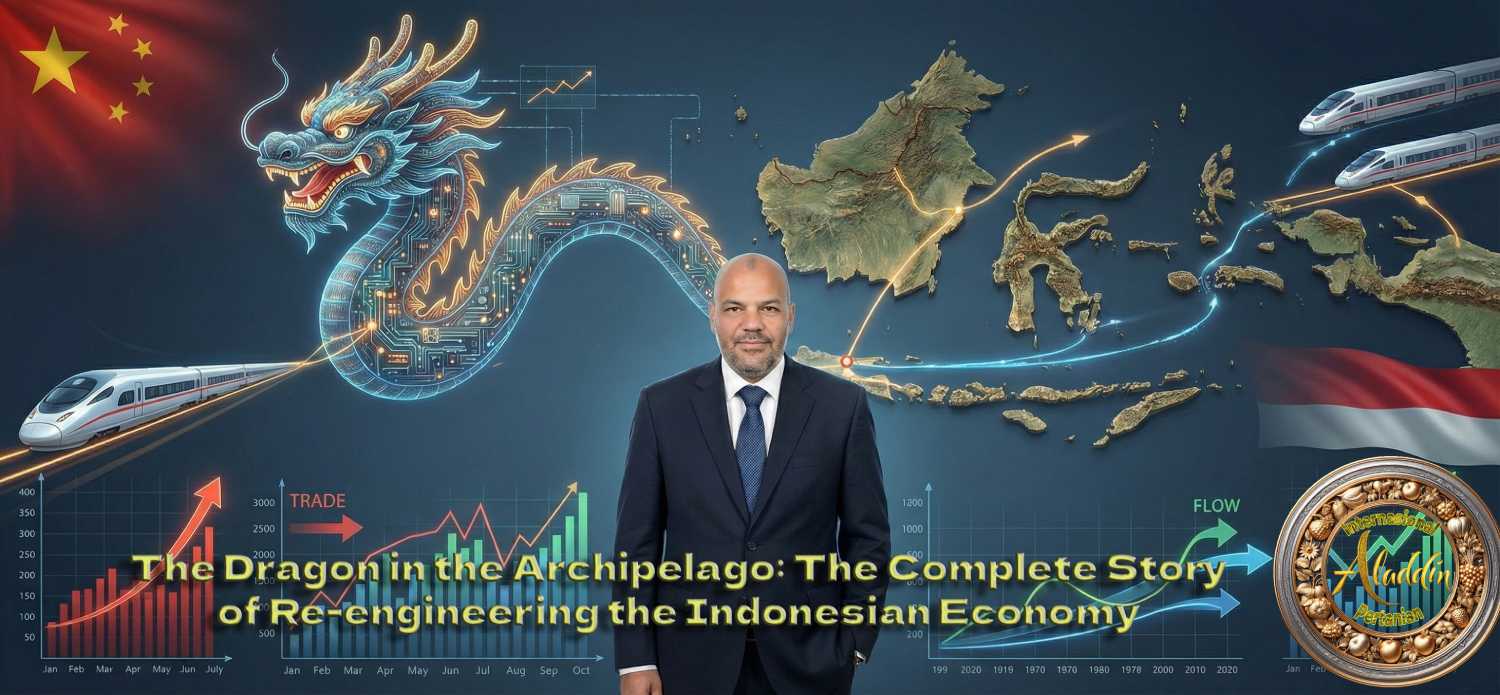
The Dragon in the Archipelago: The Complete Story of Re-engineering the Indonesian Economy
Documents and Figures Reveal the "Chinese Earthquake"
Jakarta – Dr. Aladdin Ali - Founder of Aladdin Pertanian Internasional Company
The whistle of the "Whoosh" high-speed train cutting through the mountains of West Java at 350 km/h was not merely an announcement of the arrival of the first high-speed rail in Southeast Asia; rather, it was a resounding cry declaring the birth of an entirely new geopolitical era in the soft underbelly of the Pacific. While the West was drowning in the bureaucracy of "Just Energy Transition Partnerships," and while Japan – the historical primary investor – was sinking in complex feasibility study calculations, the Chinese "Dragon" was devouring distances and opportunities in the world's largest archipelago.
Here, we are not speaking of mere traditional trade exchange, but of astounding financial and industrial engineering that has reshaped the DNA of the Indonesian economy. It is the story of an investment "earthquake" that reached a magnitude of 1,306% in a single decade, and absolute dominance whose threads extend from the depths of dark nickel mines in Sulawesi to the algorithms of smartphones in Jakarta. This documentary investigation dives deep into strategic data for the period (2020-2025), revealing with figures and facts how Indonesia transformed into the "Jewel of the Crown" in the Belt and Road Initiative, and the heavy price – in blood and coal – paid silently behind the scenes.
Chapter One: "Active Alignment"... When Jakarta Decided to Change Compass
The Chinese rush towards Indonesia was not a coincidence, but the product of precise "Strategic Synchronicity" between two agendas: China's "Belt and Road Initiative" (BRI), seeking maritime outlets and resources, and the agenda of former Indonesian President Joko Widodo, and current President Prabowo Subianto, known as the "Global Maritime Fulcrum" and the policy of "Hilirisasi" or domestic resource processing.
Jakarta has developed a new political doctrine known as "Active Alignment." Instead of passive neutrality, the Indonesian political elite decided to fully engage with Beijing to secure rapid economic growth, while attempting to maintain the security umbrella with the West.
Financial data reveals a seismic shift in the structure of foreign investment. within just one decade (2015-2024), Chinese Foreign Direct Investment (FDI) in Indonesia skyrocketed by an astronomical 1,306%. From modest investments not exceeding $0.6 billion in 2015, the figure reached $8.1 billion in 2024.
But do official numbers tell the whole story?
When dissecting Q3 2024 data, we find a deceptive scene. Officially, China ranks third with $1.86 billion, while Singapore tops the list with $5.50 billion. However, deep strategic analysis reveals what experts call "Re-routing."
| Official Rank | Country | Investment (Q3 2024) | Strategic Reality (Behind the Number) |
|---|---|---|---|
| 1 | Singapore | $5.50 billion | Acts as a major "offshore" channel for Chinese capital flow to circumvent geopolitical risks. |
| 2 | Hong Kong | $2.24 billion | Considered the traditional back door for collecting and re-injecting funds from mainland China. |
| 3 | China | $1.86 billion | This is only "direct" capital. When indirect flows are combined, China becomes the undisputed number one investor. |
| 4 | Malaysia | $0.99 billion | Traditional regional investments. |
| 5 | United States | $0.84 billion | Clear decline, with narrow focus on services and legacy mining (such as Freeport mines). |
Geographically, investment is no longer confined to the central island of Java. New Chinese spheres of influence in "Central Sulawesi" (stronghold of the IMIP complex) and "North Maluku" (stronghold of the IWIP complex) have captured market shares of 15% and 7.3% of total foreign investment in the country respectively, a geographical shift that precisely follows mineral wealth maps.
Chapter Two: Trade Deficit... The Trap of Technological Dependency
Dominance is not limited to investment but extends to creating a chronic structural trade deficit. In 2024, Indonesia's imports from China reached $73.8 billion, representing 31.4% of the country's total imports, according to data from the Central Statistics Agency (BPS).
This massive figure hides dangerous technological dependency within its folds. The vast majority of these imports are not simple consumer goods, but capital machinery, mechanical appliances, and electrical equipment. In other words: Indonesia is importing the Chinese "factory" to build its economy. This reliance creates immense political leverage; any slowdown in Chinese supply chains means an immediate halt to manufacturing engines in Jakarta.
Chapter Three: "Build First" Strategy... Why Did the West Lose the Race?
At a time when the United States and Japan were offering proposals burdened with governance conditions, environmental impact studies, and demands for legal reforms (such as the stumbling "Just Energy Transition Partnership" JETP valued at $20 billion), China came with a simple and seductive slogan for politicians: "Build First".
Chinese actors operate on timelines 30% to 50% faster than their competitors. This "speed" is not just an operational advantage, but a strategic asset that resonates with Indonesia's short election cycles, where leaders need to cut ribbons quickly.
The Jakarta-Bandung High-Speed Railway (KCIC) project serves as the living example of this model, with all its successes and failures:
- The First Maneuver: In 2015, China displaced Japan with an offer "free of government guarantees" (B2B), estimating the cost at $5.5 billion.
- The Financial Shock: As implementation began, the project faced complications in land acquisition, causing the final cost to balloon to $7.27 billion, with a Cost Overrun of $1.2 billion.
- Submission to Reality: The Indonesian government was forced to backtrack on the "no state budget use" condition, injecting State Capital (PMN) and issuing guarantees to rescue the project.
- Fierce Negotiations: The China Development Bank (CDB) financed 75% of the project. While interest started at 4%, Jakarta succeeded after arduous negotiations in lowering it to 3.4%, yet it remained higher than traditional Japanese loans.
- The Result: Despite the controversy, the train opened in October 2023, becoming a tangible symbol of modernization that "invisible" Western grants cannot compete with.
Chapter Four: The Nickel Empire... Controlling the "Oil of the 21st Century"
If the train is the shiny façade, nickel is the dark "beating heart" of Chinese dominance. Chinese companies today control 90% of total nickel processing facilities (smelters and mines) in Indonesia, with staggering cumulative investments exceeding $65 billion, according to data from (Discovery Alert, 2025).
This dominance is encapsulated in the "Indonesia Morowali Industrial Park" (IMIP), which tells the story of the Chinese ascent:
- The Smart Start (2009): Years before global attention, the giant "Tsingshan" group entered a strategic partnership with the Indonesian "Bintangdelapan" group, owned by influential retired generals, to ensure political cover.
- The Investment Explosion: By 2022, cumulative investment in this complex alone reached $20.93 billion.
- Industrial Monopoly: The complex annually produces 4.76 million tons of Nickel Pig Iron (NPI), equivalent to 50% of Indonesia's production.
- "Turnkey" System: China did not just build smelters, but ports, power plants, and worker housing. It imported everything, creating a closed ecosystem.
- The Price Trap: Chinese companies used a "Monopsony" mechanism (buying monopoly). After the government banned raw ore exports, local mine owners found no buyer other than Chinese smelters.
Chapter Five: Digital Encirclement... From Infrastructure to Consumer Pockets
Beijing did not stop at iron and steel but executed a comprehensive "digital encirclement" operation, recording figures that place it at the forefront of the future landscape:
"Huawei" and "ZTE" control over 50% of telecommunications infrastructure. Cheap and efficient Chinese technology was behind expanding 4G coverage from 30% in 2015 to over 90% in 2023. To ensure future loyalty, Huawei pledged to train 100,000 Indonesian cadres in cybersecurity (2020-2025).
In a dramatic scene in 2023, the Indonesian government banned trading on social media platforms (Project S). Instead of withdrawing, "TikTok" executed a strategic pivot with an acquisition deal for 75% of the "Tokopedia" platform – the national e-commerce champion – for $840 million.
- The Result: A giant entity controlling 28.4% of the e-commerce market in Southeast Asia.
- Explosive Growth: The Gross Merchandise Value (GMV) of TikTok Shop grew from $4.4 billion (2022) to $16.3 billion (2023), a growth of 370%.
Chapter Six: "Glocalization"... How Chinese Brands Conquered the Street?
Chinese brands succeeded where the West and Japan failed: understanding the "psychology" of the Indonesian consumer through a "Glocalization" strategy.
- The Electric Vehicle War: While Toyota hesitated, "Wuling" pounced on the market with its car (Air EV) at a price ranging between $13,000 and $20,000, perfectly suiting the middle class.
- Tax Intelligence: "Wuling" achieved a Local Content Requirement (TKDN) of 40%, qualifying it for tax exemptions that reduced VAT to 1%.
- The "Mixue" Phenomenon: The Chinese beverage chain invaded cities with a low-cost franchise system, with keen attention to obtaining "Halal" certification to break the cultural barrier.
Chapter Seven: The Dark Side of the Miracle... Blood, Coal, and Tensions
Behind the glitter of numbers, lies a catastrophic and unspoken record. The Chinese model based on "Speed Above All" comes at a steep price.
"Morning of December 24, 2023: The (ITSS) smelter in Morowali turned into an inferno. A furnace explosion led to the death of 21 workers in an instant."
The Record of Blood: Data indicates over 40 deaths occurred in the IMIP complex alone between 2015 and 2024. Data from (TrendAsia) raises the figure to 114 deaths in the nickel industry as a whole. Documented violations include wage disparities, passport confiscation, and union prohibition.
"Dirty" Nickel: Environmentally, Chinese smelters rely on "Captive Coal Plants". Data indicates that every 1 gigawatt of these plants produces 5 million tons of carbon annually, threatening to close Western markets to Indonesian exports due to Carbon Border Adjustment Mechanisms (CBAM).
Conclusion: At the Crossroads
China has succeeded in delivering what the West failed to: investments of $65 billion in nickel, a train that shortens time, and an army of technicians. But this model, based on "Production First, Safety Later," has begun to show deep cracks.
With the rise of President Prabowo Subianto, Indonesia stands today at a strategic crossroads. Will it continue to be the Dragon's industrial "backyard," or will it succeed in using "Active Alignment" to attract new competitors offering an alternative based on quality, sustainability, and fair partnership? The answer will shape the economy of Southeast Asia for decades to come.
- BKPM & BPS: Investment Realization Reports (2020-2025).
- UN Comtrade (2024) - Indonesia-China Trade Data.
- World Bank (2023) - Infrastructure Projects in Indonesia.
- McKinsey (2024) - Consumer Behavior in Southeast Asia.
- SCMP (2023) - Jakarta-Bandung HSR Case Study.
- Bloomberg (2024) - Nickel Industry Investments.
- TrendAsia & Jatam & China Labor Watch.
- Discovery Alert (2025).
- And other documented strategic reports.
All rights reserved © 2025 - All rights to this work are reserved by the author, Dr. Aladdin Ali. The content of these articles may not be copied, distributed, modified, or reproduced electronically or mechanically in any form without the written permission of the author. Respecting the intellectual property rights of the author is crucial for protecting the work and supporting future endeavours.